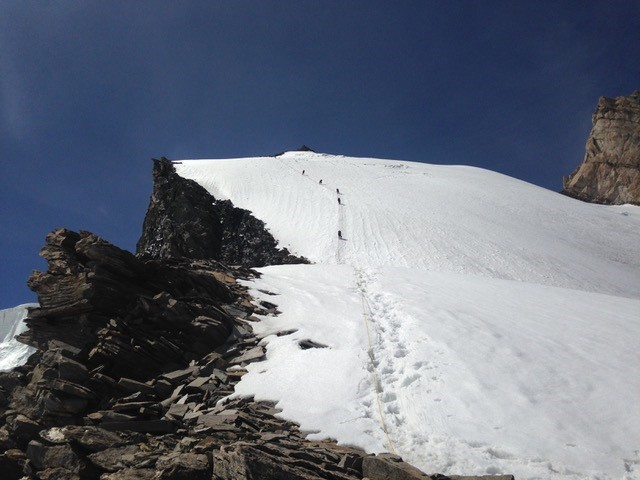
Kun | 7077 mtr. Ladakh, India

Kun | 7077m – Ladakh, India

Climb Kun (7,077m/23,218ft) with Ladakh Nomad Expedition

Duration: 23 days

Trip codeKUN EXP. 001Days23 Days
DifficultyChallengeMax altitude7077m
CategoryClimbGroup sizeMin. 2 – Max. 10
Accomodation TripHotelRegionGreat Himalaya range
CountryLadakh IndiaMealAll meals included during the trek
Starts fromDelhiEnds atDelhi
  • Climb Kun (7,077m / 23,218ft) with  Ladakh Nomad Expeditions
  • A chance to climb one of the most easiest approachable 7000m+ peak in the Indian Himalayas – Kun 7077m
  • Kun is a stunning mountain, the second highest peak in between the Zanskar and Kargil regions of Ladakh in the far Western Himalayas of the Nun Kun massif.
  • The mountain was first climbed by an Italian team of Mario Piacenza, Lorenzo Borelli in 1913 via the North – East ridge.
  • We are seeking a small team of experienced and committed mountaineers with previous altitude experience to 6000m and technical alpine climbing experience of Moderate to Difficile standard to join us on the climb.
  • This expedition is suitable for people having atleast some mountaineering skills with a very good fitness level, wanting a high altitude mountaineering adventure. This mountain is an absolute introduction to cross the 7000m+ mark for anyone with some mountaineering knowledge, having good physical ability and who have the experience of climbing atleast one 6000m+ mountain or any other mountains across the Himalayas or in any other mountain ranges. This mountain will test your climbing skills and your fitness level.
  • This is a traditional expedition style climb with multiple camps on the mountain and a fixed base camp. Fixed ropes will be used on the sections of the climb wherever it may be necessary. We will have an acclimatisation trek before the climb or on an easier 6000m+ peak(optional)
  • The approach to Kun Base Camp is appealingly short and easily accessible
  • Leaders: Rigzin Tsewang is experienced and strong Mountain Guides who has guided on this mountain for the past 10 years continuously with a very good safety and success record. Out of 7 expeditions 5 successfully made it to the summit.  Rigzin has led more than 200 above 6000m included many 7000m and unclimbed peaks. They have solid credentials as a Mountain guides.
  • We are taking bookings for expeditions in 2024 and following years.
  • 2024 Dates: July 2024 Contact us
  • The best climbing period is July to mid of October.
  • Grade: AD+
  • Strenuous climb, Good mountaineering skills required with a very good fitness level. Previous experience of climbing a 6000m+ mountain is prerequisite or
  • a few previous mountaineering experiences would be an added bonus
  • Trip numbers, at least 4 6000er peaks.
  • max of 6 with 1 Mountain Guide and support Climbing Guides (Sherpas)

Snapshot Itinerary:

Day 01: Delhi - briefing at Indian Mountaineering Foundation (IMF)
  • Arrive at Delhi and attend briefing at IMF
  • We will greet you at Delhi international airport and drive you to your hotel. We will go to the IMF for a briefing session. where we will get our climbing permit and meet our Liaison Officer. We can also visit the mountaineering museum in the same building.
  • Fly from Delhi to Leh (3,500m/11,483ft)
  • Welcome to Leh, the capital of Ladakh, a large town tucked far in between the great mountain ranges of the Himalayas and East Karakoram and part of the great Trans Himalayan range. Your early morning 75 minute flight to Leh, the capital of Ladakh, over the Himalayas will be one of the most picturesque flights you’ll ever experience. If you sit on the left side of the plane, you will see Nun (7,135m / 23,409ft) and Kun (7,077m / 23,219ft), one of the two highest mountains in far western Ladakh. If the sky is clear, on the Northern horizon you will see K2 (8,611m / 28,251ft), the world’s second highest peak, and other 8000m peaks of the Karakoram Range.
  • We will greet you at Leh airport and drive you to your hotel or home stay. The rest of the day depends on your jet lag and acclimatization to Leh’s high altitude. We can take an evening stroll in the old Leh town with narrow alleys with muslim bakeries, Tibetan monasteries, Tibetan and Kashmiri antique shops, and a bustling Main Bazaar.
  • Acclimatisation and guided tour to Hemis Monastery and Thiksey Monastery
  • First half of the day:
  • Ladakh is the only place besides Tibet where almost all the major sects of Tibetan Buddhism still exist. You will see architecture and a lifestyle similar to Central Tibetan traditions and visit Hemis Monastery and Thiksey Monastery.
  • Tibetan Buddhism has been an integral part for the people of Ladakh for centuries, visiting a monastery can only do justice to know a bit about this centuries old tradition.
  • Hemis Monastery, belonging to the Drukpa Kagyu sect, is the largest Tibetan Buddhist monastery in Ladakh. It was first built in the 11th century. Stories of Kalachakra and the Lords of the Four Quarters are etched on the walls of its ancient corridors. There are golden statues, precious stones and a library with Tibetan books, relics and manuscripts.
  • The Hemis Festival is a dazzling celebration of the birth of the Guru Rinpoche (Padmasambhava). The Cham Dance (masked dance by the monks) should not be missed at Hemis Monastery.
  • Thiksey Monastery, belonging  to the Gelugpa sect, is 12 stories high. It has 10 temples, showcases stunning Ladakhi architecture, a 15m high statue of Maitreya (future Buddha), fierce paintings and statues of deities and other Tibetan Buddhism artifacts.
  • Second half of the day(Optional):
  • Today is another rest day for you to get acclimatised and enjoy the peaceful atmosphere, the bustling Main Bazaar and explore the 17th century Leh Palace built by the King Singge Namgyal with Namgyal Tsemo Gompa perched on the top. Leh town is a bustling scene during the summer season and is packed with Kashmiri and Tibetan antique shops, many restaurants and cafes, muslim bakeries tucked behind the picturesque mosque in narrow alleys, and Ladakhi women selling vegetables and fruits and the people from Da Hanu selling their dried fruits and nuts at the end in the Main Bazaar.
  • Ladakh was once an integral part of Western Tibet and a major trading hub along the Silk Route. Caravans of merchants from far-flung areas such as Tibet, Yarkand, Kashgar, Northern lower India passed through Leh trading salts, wool, pashmina, spices, tea and semi-precious stones, everyone leaving a mark on this unique ancient capital.
  • We can also go for a walk up to the Namgyal Tsemo Gompa which overlooks the panoramic view of Leh and Leh Palace. We can visit the Central Asian Museum, and the nearby gompas (tibetan buddhist monasteries). The architecture of Leh Place resembles that of the Great Potala Palace in Lhasa, Tibet. It will be great to walk the streets of changspa and climb up the many steps which leads us to the Japanese built Shanti Stupa to get a great view of the surrounding villages filled with green fields, willows and poplar trees and white washed Ladakhi houses. The precariously perched Leh Palace and Tsemo Gompa is on the eastern flank.
  • You can get view as far as to the Indus River and beyond that of the Stok range. Walking down we can visit the Sankar Gompa (17th – 18th century) which is the summer palace of Bakula Rinpoche (highly incarnated lama). This is tucked in between the Sankar village, amidst the groves of willow and poplar trees.

Day hike from gyamtsa to phyang village and overnight at Hotel.

  • Drive from Leh to Alchi Monastery, Lamayuru Monastery and Kargil (2,676m/8,780ft)
  • Much of our time will be spent driving to Kargil today. At Lamayuru, we will encounter landscape which has been compared to the moon’s surface. If time allows, we will visit Alchi Monastery and Lamayuru Monastery on the way to Kargil.
  • Located on the South bank of the Indus River, Alchi Monastery is said to be built between 958 AD and 1055 AD. Alchi Monastery belongs to the Gelugpa sect and contains some of the oldest surviving paintings of Buddhism and Hindu Kings. It also contains huge statues of the Buddha and elaborate wood carvings and artwork.
  • Lamayuru Monastery (belonging to the Drikung Kagyu sect) is one of the largest and oldest monasteries in Ladakh, dating back to the 10th century. Approximately 150 monks reside at the monastery. The monastery houses a rich collection of artifacts, wall paintings, statues and carpets.
  • Drive from Kargil to Shafat Valley (a.k.a. Golmatangus, 3,700m/12,139ft)
  • From Kargil, we will drive along the Suru River through a valley, taking breaks in small villages. Today, we will see Kun and Nun for the first time. We will camp in a large meadow next to Suru River in the Shafat Valley.
  • Trek to Base Camp (4,650m/15,256ft, 6 hours)
  • We will cross a bridge over Suru River and ascend through meadows covered in Edelweiss flowers. We will cross the glacial moraines to reach Kun Base Camp.
  • Rest and sort gear at Base Camp
  • We will prepare the equipment, gear and food for the climb.
  • climbing days (including rest days and days for contingencies)
  • Base camp (4,650m/15,256ft) to Camp 1 (5,340m/17,520ft, 4-5 hours ascent, 2 hours decent)
  • The route crosses small rivers in moraine terrain. After setting up a gear stash in this area we will continue to ascend and negotiate several small crevasses.
  • Camp 1 (5,340m / 17,520ft) to Camp 2 (6,120m / 20,079ft, 8 hours ascent)
  • The route involves ascending 800m on 30-35 and 40-45 degree steep snow slopes using fixed lines. A snow plateau between Nun and Kun is where Camp 2 is situated. Climbers look directly at the rock and ice face of Kun here.
  • Camp 2 (6,120m/20,079ft) to Camp 3 (6,330m/20,768ft, 3-4 hours ascent)
  • The route involves crossing the snowy plateau between Nun and Kun. We will rest in Camp 3 before climbing to the summit with an alpine start.
  • Summit day (7,077m/23,219ft, ascend and descend in 12-15 hours)
  • The route involves ascending a ridge and a 50 degree+ steep snow slope using fixed lines. The summit view is undoubtedly spectacular. After summiting, we will descend as far as we can go to the lower camps, e.g. Camp 3. The next day, we will descend to Kun Base Camp.
  • Trek from Kun base camp (4,650m / 15,256ft) to Shafat Valley (3,700m / 12,139ft)
  • Today we will return to Shafat Valley. Horses or mules will carry most of our gear from Kun Base Camp to Shafat Valley.
  • Drive from Shafat Valley to Kargil or Leh
  • We will drive to Kargil or Leh.
  • Drive from Kargil to Leh, or relax in Leh.
  • Enjoy Leh’s attractions and prepare for your flight out to Delhi tomorrow.
  • Leh – Delhi – IMF debrief
  • Upon arrival in Delhi in the afternoon, we will go to the IMF for the expedition’s debriefing.
  • Here, the expedition officially ends.
  • Please note: This itinerary is approximate. Clients are embarking on adventure travel in a remote mountain region and the itinerary is subject to weather, road conditions, vehicles and local availability of horses or mules. Ladakh Nomad Expeditions will make every effort to see that clients acclimatize completely, and complete and enjoy their trip.

Please read Ladakh Nomad Expeditions Terms and Conditions and Legal. Prices are in US dollars and are subject to change.

Submit An Enquiry

Customize

Travel Package!

60+ Guide Await to Help You

Include Features

Exclude Features

26

+
Tour Completed

12

+
Travel Experience

20

+
Happy Traveler

98

%
Retention Rate